
🎧 Listen to this article (full narration)
Table of Contents
- What Bioavailability Actually Means for Liquid Mineral Supplements
- Liquid Minerals vs Tablets: What the Evidence Actually Shows
- Ionic Minerals Absorption: Why Nutrient Form Decides the Outcome
- Factors Affecting Mineral Absorption You Can Control
- Taking Mineral Supplements With Food: Timing, Dosage, and Serving Size
- How to Read a Liquid Mineral Supplement Label Before You Buy
- Frequently Asked Questions
Last Updated: October 17, 2026
What Bioavailability Actually Means for Liquid Mineral Supplements
Bioavailability is the share of a nutrient that actually reaches your bloodstream and gets used by your cells. It is not the same as how much you swallow.
Here is the short answer: liquid mineral supplements can be bioavailable, but the liquid form alone does not guarantee it. The nutrient's chemical form, the dose, your stomach contents, and your individual digestion all matter more than whether the product pours or pills.
That is the core tension in this whole category. Sellers treat "liquid" as a synonym for "absorbable." It isn't.
Dissolution, Absorption, and Bioavailability Are Not the Same Thing
Three terms get used interchangeably in supplement marketing. They describe different steps, and confusing them is the most common mistake we see.
- Dissolution is the tablet or capsule breaking apart in your gut so the nutrient is released.
- Absorption is the nutrient crossing the intestinal wall into your bloodstream.
- Bioavailability is the fraction of the dose that ends up in circulation and available to your tissues.
A tablet can dissolve fully and still deliver poorly. A liquid is already dissolved, so it skips step one. That is a real advantage, but it only removes one bottleneck. It says nothing about how well the mineral crosses the gut wall or how much your body retains.
Liquid Minerals vs Tablets: What the Evidence Actually Shows
The honest answer is that the evidence is mixed and often overstated. Many businesses find liquids are easier to swallow and gentler on the stomach, especially for people who struggle with large pills.
But the claim that liquids are universally more bioavailable than tablets is not well supported. Most comparison studies are small, use different doses, and measure different things. Some show faster absorption for liquids.
What most guides miss is the distinction between speed and total. A liquid may hit your bloodstream sooner. That does not mean more of it gets absorbed overall.
| Question | Liquid | Tablet or Capsule |
|---|---|---|
| Needs to dissolve first? | No | Yes |
| Absorbs faster? | Often | Slower |
| Total amount absorbed | Depends on form | Depends on form |
| Easy to swallow | Yes | Can be hard |
| Dose accuracy | Drops vary | Fixed per pill |
| Stomach tolerance | Often gentler | Varies |
The practical takeaway: choose liquid for convenience and tolerance, not because it is guaranteed to be more bioavailable.
Ionic Minerals Absorption: Why Nutrient Form Decides the Outcome
The mineral's chemical form matters more than the delivery method, and this is where most liquid-versus-tablet arguments go off the rails. A liquid oxide is still oxide. A well-made chelated capsule can outperform a poorly formulated liquid. To judge bioavailability honestly, you have to look at the form on the label, not the format on the shelf.
Minerals travel in two broad families. Ionic minerals are dissolved, charged particles, the form most liquid products rely on.
A Mineral-by-Mineral Look at Common Forms
| Mineral | Common forms | What the form means in practice |
|---|---|---|
| Magnesium | Oxide, citrate, glycinate, malate | Oxide is cheap and poorly absorbed; citrate dissolves well and is absorbed reasonably but can loosen stools; glycinate is gentle and often chosen for tolerance; malate is frequently picked for daytime use |
| Iron | Ferrous sulfate, ferrous bisglycinate, carbonyl iron | Ferrous sulfate is well studied but can cause GI upset; bisglycinate is a chelate often chosen for gentler tolerance; carbonyl iron is denser and used where lower GI irritation matters |
| Zinc | Oxide, citrate, gluconate, picolinate | Oxide is common but less well absorbed; citrate and gluconate are frequently used in lozenges and capsules; picolinate is marketed for uptake but the evidence is not decisive |
| Calcium | Carbonate, citrate | Carbonate needs stomach acid and is best with food; citrate absorbs with or without food and is often preferred for lower acid production |
| Selenium | Selenomethionine, sodium selenite | Selenomethionine is an organic form the body can incorporate into proteins; selenite is inorganic and handled differently |
| Chromium | Picolinate, chloride | Picolinate is the most marketed form; evidence on superiority over other forms is mixed |
Two patterns stand out. First, the "best" form depends on the mineral and the intended use, magnesium glycinate for tolerance, magnesium citrate when regularity is welcome, calcium citrate when stomach acid is low. Second, the same mineral can behave very differently across forms, which is why a blanket claim that "liquid minerals are more bioavailable" collapses under scrutiny.
Why Ionic Liquids Can Still Underperform
Ionic minerals have a real advantage: they are already dissolved, so they skip the disintegration step that tablets must clear. But dissolved does not mean absorbed. Charged minerals in a liquid can bind to other ingredients in the bottle, compete with each other in the gut, or simply pass through if the dose is small and the form is poorly chosen. A liquid magnesium oxide product is still magnesium oxide, and its absorption ceiling is set by the oxide, not the dropper.
- Ionic forms: fast to dissolve, but can compete and irritate
- Chelated forms: protected through digestion, often better absorbed for select minerals
- Oxide forms: inexpensive, generally low absorption
- Methylated forms: better used for certain B vitamins, not a mineral category
Factors Affecting Mineral Absorption You Can Control
Several factors affecting mineral absorption sit squarely in your hands. You cannot change your genetics, but you can change how and when you take a supplement.
Here is what moves the needle:
- Take with or without food. Some minerals absorb better on an empty stomach; others need food to avoid nausea.
- Watch for competitors. Calcium, iron, and zinc compete for the same pathways. Space them apart.
- Add vitamin C. It can enhance iron absorption when taken together.
- Avoid tannins and phytates at the same time. Coffee, tea, and high-fiber meals can bind minerals and reduce uptake.
- Split your dose. Smaller amounts absorbed more often often beat one large dose.
A common mistake is taking a big mineral dose all at once and assuming more is better. Absorption tends to drop as the dose climbs. Splitting the serving size across the day usually works better.
Taking Mineral Supplements With Food: Timing, Dosage, and Serving Size
Timing and dose decide more than most people realize. Taking mineral supplements with food is often the safer default, because it reduces stomach upset and can improve tolerance.
But "with food" is not a universal rule. Some minerals absorb better away from meals. The right call depends on the specific mineral and your stomach.
Dosage and serving size matter just as much. The label tells you the serving size, but not always the elemental mineral amount.
- Check the elemental amount, not just the compound weight
- Start low and adjust
- Take consistently rather than sporadically
- Keep competing minerals apart by a couple of hours
If you have a sensitive stomach or take medications, talk to your doctor before starting any mineral supplement. Mineral interactions with prescriptions are real.
How to Read a Liquid Mineral Supplement Label Before You Buy
A label tells you almost everything you need if you know where to look, and liquid products make it easy to hide a weak dose behind a small serving size. Read it in this order, and do the arithmetic before you trust any absorption claim.
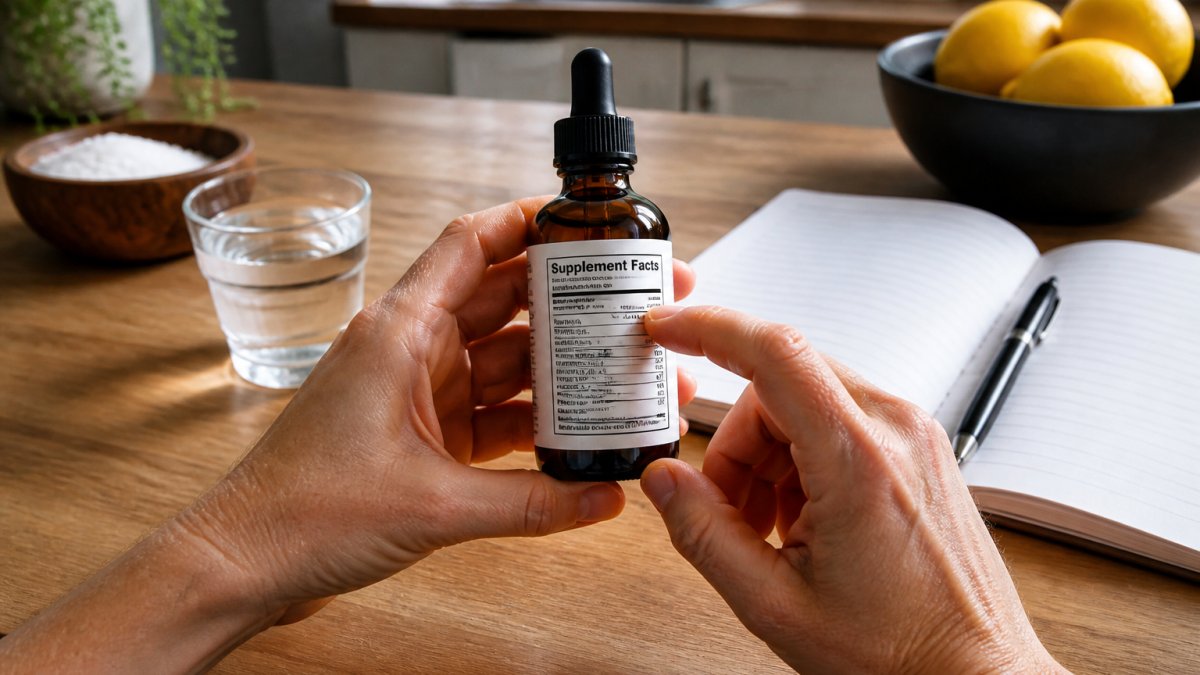
The Six-Point Label Check
- Serving size and servings per container. A tiny serving hides a weak dose. If the label says "1 dropper" and the bottle holds 30 servings, confirm the dropper volume matches what you will actually take.
- Elemental mineral amounts. This is the amount of the actual mineral, separate from the compound it is bound to. A large compound weight can deliver a small elemental dose, always compare elemental numbers across products.
- Nutrient form. Look for citrate, glycinate, bisglycinate, or chelated forms over oxides when absorption matters. The form is the single most predictive line on the label.
- Other ingredients. Watch for fillers, sweeteners, preservatives, and added minerals that compete for absorption pathways.
- Third-party testing. Look for independent verification, a certificate of analysis, a named testing lab, or a recognized verification program, not just in-house claims.
- Source and processing. Where the minerals come from and how they are made affect consistency, but sourcing claims are not the same as absorption evidence.
Do the Elemental-Dose Math
Elemental mineral is the actual amount of the mineral you get, separate from the compound it is bound to. This is the step most shoppers skip. If a label lists a compound weight, the elemental amount is typically a fraction of it, sometimes a small fraction. Two products can show the same compound weight and deliver very different elemental doses.
A common pattern is a liquid product with a generous-sounding compound number and a modest elemental number. That is not automatically a bad product, but it is a reason to read the serving size and elemental line together before deciding the dose is meaningful.
Vet the Absorption Claim
What most labels won't tell you is whether the product is genuinely more bioavailable. That is a marketing claim, not a guarantee. Treat "high absorption," "nano," and "cellular" language as a prompt to check the form and dose yourself. A repeatable test:
- Does the label name the chemical form? If not, assume the cheapest form until proven otherwise.
- Does it state elemental amounts per serving? If not, the dose is unverifiable.
- Is there independent testing named? If not, the claim rests on the seller's word.
- Does the absorption claim come with a study, a dose, and an endpoint? If not, it is marketing.
If you have a sensitive stomach or take medications, talk to your doctor before starting any mineral supplement. Mineral interactions with prescriptions are real, and a label cannot tell you whether a product is right for your situation.
At Ormusminerals, we source our full-spectrum mineral elements from authentic Dead Sea salt and Atlantic Ocean water, refined through an alkaline precipitation process we have developed over 15 years. Our Magnesium Oil with Ormus and Life Force Energy Fulvic Acid Minerals are built around that full-spectrum approach, and we offer free US shipping on orders over $50.


Frequently Asked Questions
Are liquid mineral supplements more bioavailable than tablets?
Not automatically. Liquids skip the tablet's dissolution step, so the mineral is already dissolved when you swallow it. But bioavailability, meaning how much of a nutrient actually reaches your bloodstream and gets used, still depends on the mineral form, the dose, your digestive health, and what else is in your stomach. A poorly formulated liquid can underperform a well-made chelated tablet. Judge a product by its nutrient form and label transparency, not by whether it is liquid.
What does bioavailability mean for mineral supplements?
Bioavailability is the share of a nutrient you swallow that gets absorbed and used by your body. It is different from dissolution, which only means the pill broke apart in your gut, and from absorption rate, which describes how quickly a nutrient crosses into the bloodstream. A supplement can dissolve fast and still be poorly absorbed. For minerals, the chemical form matters most: magnesium citrate and chelated minerals tend to be absorbed more efficiently than inexpensive oxide forms.
Which factors affect how well minerals are absorbed?
Several factors affect mineral absorption: the nutrient form (chelated minerals and methylated B12 outperform cheap oxides), your stomach acid and digestive health, competition between minerals like calcium and iron taken together, and whether you take the supplement with food or on an empty stomach. Phytates in whole grains and tannins in coffee or tea can bind minerals and reduce uptake. Splitting doses and taking minerals consistently matters more than chasing a single perfect timing window.
Can mineral supplements interfere with medications or other nutrients?
Yes. Minerals can bind certain medications and reduce how well both work. Calcium and magnesium can interfere with some antibiotics and thyroid medication, and zinc competes with copper when taken in high doses for long periods. If you take prescription drugs, separate mineral supplements by at least two hours from those medications and talk to your doctor or pharmacist before starting. A liquid format does not remove these interactions.
0 comments