
🎧 Listen to this article (full narration)

Excellent question. You're asking about a mineral that is a perfect example of the principle: "The smallest things can have the biggest impact."

Molybdenum (Mo) is an essential micronutrient for plants. This means they need it in absolutely minuscule amounts—parts per million. However, without this tiny amount, two of the most critical processes for life on Earth would grind to a halt.
Molybdenum's primary role can be summarized in one phrase: It is the "Master Key" that unlocks Nitrogen.
Nitrogen is a macronutrient that plants need in huge quantities for growth, but it often exists in forms they can't use. Molybdenum is the essential component of the specific enzymes that convert useless nitrogen into life-sustaining compounds.
Here are its two critical roles.
Role 1: Converting Soil Nitrogen into Food (Nitrate Reductase)
-
The Problem: The main form of nitrogen that plants absorb from the soil is nitrate (NO₃⁻). However, in this form, it's completely useless to the plant. It's like having crude oil but no refinery.
-
The Solution: Plants produce an enzyme called Nitrate Reductase. This enzyme is the "refinery." Its job is to take the unusable nitrate and convert it into nitrite (NO₂⁻), which is the first step in turning it into ammonia and amino acids—the building blocks of protein.
-
Molybdenum's Role: Molybdenum is the essential, non-negotiable core atom of the Nitrate Reductase enzyme. Without molybdenum, the plant cannot create this enzyme.
The result: If a plant is deficient in molybdenum, it can be sitting in soil packed with nitrates and literally starve to death because it lacks the "key" to unlock and use that food.
Role 2: Fixing Atmospheric Nitrogen (Nitrogenase)
This is one of the miracles of the plant kingdom, performed by legumes (beans, peas, clover, alfalfa).
-
The Problem: The air we breathe is 78% nitrogen gas (N₂). This is a vast, unlimited reservoir of nitrogen, but it's completely inert and unavailable to plants.
-
The Solution (The "Superpower" of Legumes): Legumes form a symbiotic relationship with soil bacteria (rhizobia) in their root nodules. These bacteria produce an enzyme called Nitrogenase. This incredible enzyme can grab nitrogen gas directly from the air and "fix" it into ammonia (NH₃), which the plant can then use to grow. This is how legumes enrich the soil.
-
Molybdenum's Role: Molybdenum is the critical active component in the Nitrogenase enzyme.
The result: If a legume is deficient in molybdenum, its root nodules cannot produce functional Nitrogenase. The plant loses its "superpower" and can no longer fix its own nitrogen from the air.
Molybdenum Deficiency Symptoms
Because molybdenum is so critical for nitrogen metabolism, its deficiency symptoms often look exactly like nitrogen deficiency:
- General yellowing of the older, lower leaves (chlorosis).
- Stunted growth and a general lack of vigor.
- Specific Symptom: In certain plants like cauliflower and broccoli, it causes a unique condition called "Whiptail," where the leaves become narrow, twisted, and deformed.
The Critical Role of Soil pH
A fascinating and crucial fact for any farmer or gardener is that molybdenum's availability is controlled by soil pH.

- In acidic soils (low pH), molybdenum becomes "locked up" and unavailable to plants.
- In alkaline soils (high pH), it becomes readily available.
This is the opposite of most other micronutrients. Therefore, a molybdenum deficiency is often not caused by a lack of the mineral in the soil, but by soil that is too acidic. The first and most common treatment is often to apply lime to the soil to raise its pH.
Molybdenum as a Catalyst for Nitrogen Assimilation
Molybdenum is an essential trace element that serves as a vital structural component of two crucial plant enzymes: nitrate reductase and nitrogenase. Nitrate reductase enables plants to convert absorbed soil nitrates into nitrite and subsequently into ammonia, which is then synthesized into proteins, nucleic acids, and chlorophyll. Without adequate molybdenum, absorbed nitrates accumulate harmlessly in leaf tissue while the plant suffers from nitrogen deficiency, exhibiting pale, yellowing leaves despite abundant soil nitrogen fertilization.
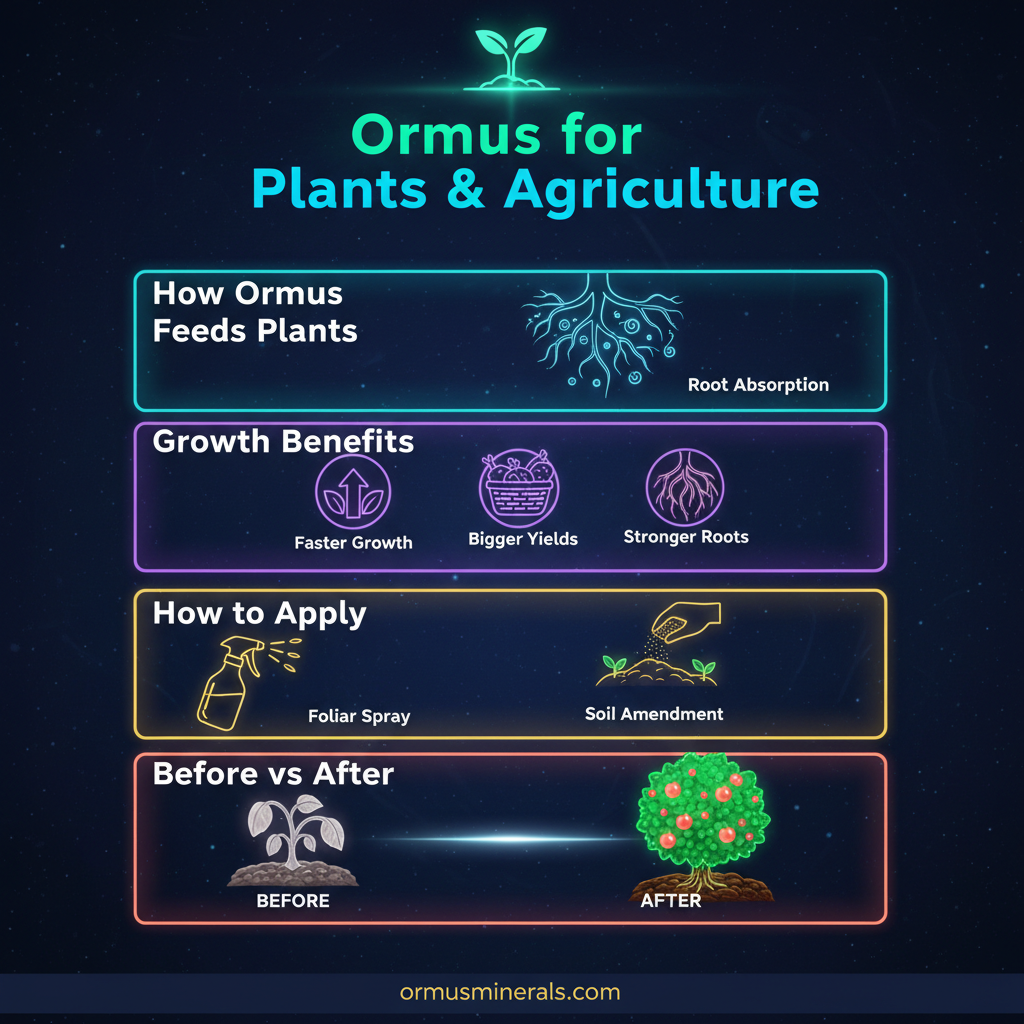
By supplying bioavailable trace molybdenum through our dedicated Ormus for Plants liquid matrix, gardeners ensure efficient nitrogen assimilation, leading to vibrant green foliage and rapid vegetative growth.
Identifying Molybdenum Deficiencies in Garden Crops
Molybdenum deficiency symptoms often mimic nitrogen deficiency, beginning with general chlorosis (yellowing) on older leaves. However, severe molybdenum deficiency causes distinct leaf cupping, interveinal mottling, and a condition known as "whip-tail" in brassica crops (such as cauliflower and broccoli), where leaf blades fail to develop fully around the main leaf vein. Because molybdenum is required in minute amounts, correcting deficiencies requires precise trace mineral applications rather than heavy chemical fertilizing.
Restoring Molybdenum and Trace Minerals with Ocean Concentrates
Natural ocean water contains molybdenum alongside over seventy complementary trace elements in ideal bio-available proportions. Applying sea mineral precipitates restores rare trace elements to depleted garden beds, ensuring plants have access to all required enzymatic cofactors without risking trace mineral toxicity.
Discover our range of ocean-derived trace element products in the Ormus collection. To learn more about identifying trace mineral deficiencies and applying liquid sea minerals to your garden, review our beginner-friendly usage guide.
Shop Molybdenum Products
Each size is also available in strengths 1x–5x. Free US shipping on orders over $50.