
🎧 Listen to this article (full narration)
Table of Contents
- What You'll Need Before Starting the Alkaline Precipitation Process
- Step 1: Prepare the Aqueous Solution and Test Baseline pH
- Step 2: Add Alkali and Adjust pH for Mineral Precipitation
- Step 3: Monitor Reaction Kinetics and Saturation State
- Step 4: Separate, Wash, and Dry the Precipitate
- M-state Mineral Extraction Methods and How They Differ
- Common Mistakes to Avoid in Alkaline Precipitation
- Safety and Environmental Compliance for Alkaline Precipitation
- Frequently Asked Questions
Last Updated: October 1, 2026
What You'll Need Before Starting the Alkaline Precipitation Process
The alkaline precipitation process uses a base to raise the pH of a mineral-rich solution until dissolved metals form solid particles that settle out. Ormusminerals has refined this process over 15 years to extract M-state minerals from Dead Sea salt and Atlantic Ocean water. Gather the right tools first.
Here is what you need:
- A clean glass or food-grade plastic container (never metal)
- Filtered or distilled water
- An alkali source, such as sodium hydroxide or potassium hydroxide
- A digital pH meter with calibration solution
- Safety glasses, nitrile gloves, and a lab apron
- A glass stirring rod or non-metal spoon
- Coffee filters or fine-mesh filter paper
- A glass dropper or pipette
Step 1: Prepare the Aqueous Solution and Test Baseline pH
Start by dissolving your mineral source in distilled water. For Dead Sea salt, use roughly one part salt to three parts water. Stir until fully dissolved.
Step 2: Add Alkali and Adjust pH for Mineral Precipitation
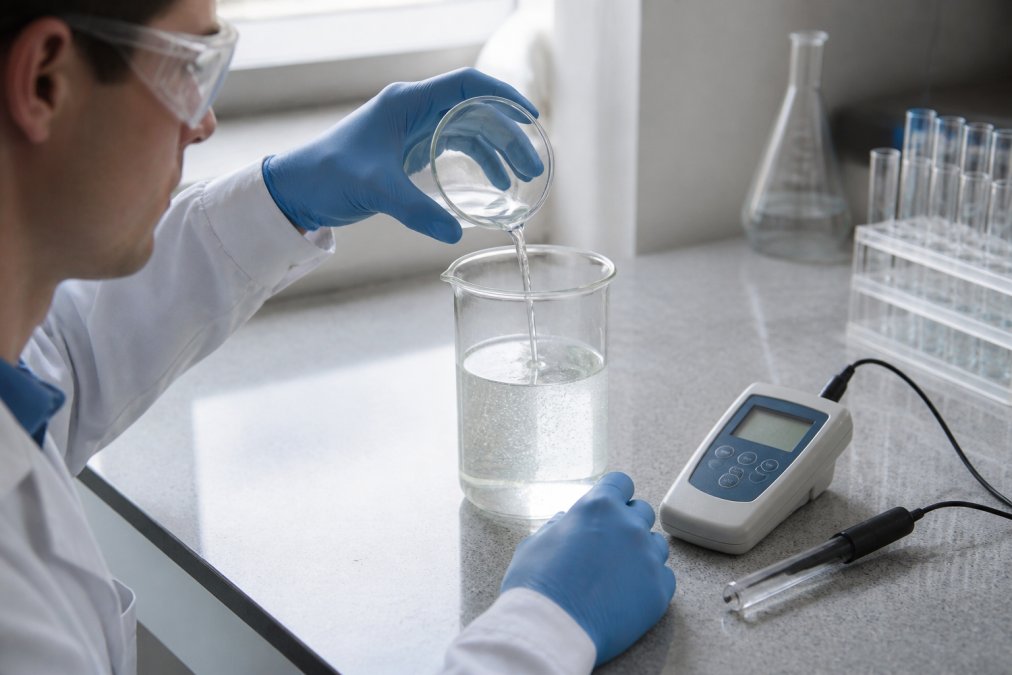
Add your alkali slowly, one drop at a time, while stirring. The target range for most mineral precipitation is pH 10.5 to pH 11.5. Adding too much at once causes rapid precipitation that traps impurities in the solid.
Choosing Your Alkali Source and Calculating Dosage
Sodium hydroxide (NaOH) is the most common choice: cheap, easy to find, and dissolves cleanly. Potassium hydroxide (KOH) works too, and some prefer it for mineral supplements because potassium is a beneficial mineral.
| Alkali Source | Strength | Best For | Watch Out For |
|---|---|---|---|
| Sodium hydroxide | Strong | General precipitation | Adds sodium to final product |
| Potassium hydroxide | Strong | Mineral supplements | Adds potassium to final product |
| Sodium carbonate | Mild | Carbonate minerals | Slower reaction, foaming |
| Ammonium hydroxide | Moderate | Lab-scale work | Strong odor, ventilation needed |
Step 3: Monitor Reaction Kinetics and Saturation State
Precipitation is a kinetic process whose speed depends on temperature, concentration, and how fast you add the alkali. Saturation state tells you how close your solution is to forming solids: once it passes the saturation point for a given mineral, that mineral drops out as a solid. Different minerals hit saturation at different pH levels, which is why one precipitate forms first, then another as pH climbs.
What Saturation Actually Means
Every sparingly soluble mineral has a solubility product constant, Ksp: for a mineral that dissociates into metal ions and hydroxide ions, Ksp equals the metal ion concentration multiplied by the hydroxide ion concentration raised to its stoichiometric power. When the actual ion product exceeds Ksp, the solution is supersaturated and the mineral precipitates; at Ksp it is at equilibrium; below Ksp the mineral stays dissolved.
- Iron(III) hydroxide begins precipitating at roughly pH 3 to 4
- Aluminum hydroxide begins around pH 4 to 5
- Copper(II) hydroxide begins around pH 6 to 7
- Zinc hydroxide begins around pH 7 to 8
- Magnesium hydroxide begins around pH 9 to 10.5
- Calcium carbonate and calcium hydroxide push higher, often above pH 11
Why Kinetics Lag Behind Thermodynamics
Thermodynamics tells you whether a mineral can precipitate; kinetics tells you how fast. A solution can be supersaturated for hours and still show no cloudiness because nucleation has not started. Primary nucleation, the first tiny crystal forming from dissolved ions, is slow because ions must cluster against an energy barrier, but once nuclei exist, secondary nucleation and crystal growth proceed much faster, which is why a seeded or slightly turbid solution precipitates faster than a perfectly clear one.
Three variables control the rate:
- Supersaturation ratio: The further past Ksp you push, the faster nucleation. This is why dumping alkali in fast creates a burst of fine particles.
- Temperature: Higher temperature raises ion mobility and reaction rate, but it also raises solubility for most hydroxides, which lowers the supersaturation driving force. The two effects fight each other.
- Agitation: Gentle stirring keeps ions in contact with growing crystals and prevents settling. Violent agitation creates shear that breaks crystals into fines.
Aging, Ostwald Ripening, and Why Stir Time Matters
After the initial precipitate forms, small, high-surface-energy particles slowly dissolve while larger ones grow, Ostwald ripening. Over 15 to 30 minutes of gentle stirring, the result is a denser, more filterable solid with less trapped liquid.
Reading the Solution
You do not need a lab to read saturation state. Watch for these signals:
- Clear to faint haze: Nucleation has just begun. Hold the alkali addition.
- Milky, uniform cloud: Active precipitation across the batch. Keep stirring.
- Distinct floc settling to the bottom: Particles are agglomerating. Good sign.
- Persistent colloid that will not settle: Supersaturation was too high or the ionic strength is too low. Add a small amount of electrolyte or extend aging time.
- Color change: Iron precipitates are rust to orange-brown, copper is blue-green, aluminum is white and gelatinous, magnesium is white and granular.
A Note on Competing Equilibria
Hydroxide precipitation does not happen in isolation. Carbonate, sulfate, and phosphate can form their own insoluble phases and compete for the same metal ions. Carbonate matters most: atmospheric carbon dioxide dissolves into alkaline solutions and forms carbonate and bicarbonate, which can precipitate calcium and magnesium as carbonates rather than hydroxides. That is one reason an open container behaves differently from a sealed one, and why the same recipe can give different results on different days.
Step 4: Separate, Wash, and Dry the Precipitate
Let the container sit undisturbed for at least 4 hours, overnight if possible, so the solid particles settle. Then pour off the clear liquid, add fresh distilled water, swirl gently, let it settle, and pour off the water. Repeat this washing step 3 to 4 times; each wash removes alkaline residues and leftover salts, and skipping washes leaves caustic residue in your final product.
M-state Mineral Extraction Methods and How They Differ
M-state minerals, sometimes called ORMUS, are a class of minerals that some researchers believe exist in a different atomic state. Extraction methods vary, but alkaline precipitation is the most widely used for home and small-scale production. The key differences come down to three factors:
- Alkali choice: Sodium vs. potassium vs. carbonate sources
- pH endpoint: Lower pH (10.5) captures fewer minerals; higher pH (11.5) captures more
- Washing technique: More washes mean purer product but lower yield
How the Same Chemistry Scales to Industry
The same alkaline precipitation chemistry that drives a home batch runs at industrial scale in three sectors.
The Two-Stage Approach in Detail
The two-stage method solves a real problem: not all metals should end up in your final product.
What Actually Separates the Methods
Strip away the branding and most M-state extraction methods differ on four variables:
- Source water: Dead Sea salt, ocean water, and inland brine each carry a different mineral profile, which changes what precipitates and at what pH.
- Alkali type: Sodium hydroxide adds sodium, potassium hydroxide adds potassium, and carbonate sources add carbonate that can shift which minerals form.
- pH endpoint and staging: Single-stage versus two-stage, and where you set the upper pH limit.
- Washing and drying: Number of rinses, water quality, and drying temperature all affect residual salts and final texture.
Common Mistakes to Avoid in Alkaline Precipitation
The biggest mistake is adding alkali too fast. Rapid pH swings create small, cloudy particles that are hard to filter and trap impurities.
Other frequent errors:
- Using metal containers or utensils (metal ions leach into the solution)
- Skipping the baseline pH reading (you cannot calculate dosage without it)
- Not washing the precipitate enough (caustic residue remains)
- Using heat to dry the final product (damages mineral structure)
- Testing pH with strips instead of a calibrated meter (not precise enough)
Safety and Environmental Compliance for Alkaline Precipitation
Alkaline solutions are caustic. They burn skin and damage eyes. Always wear safety glasses, nitrile gloves, and long sleeves. Work in a ventilated area.
Frequently Asked Questions
What is the alkaline precipitation process for minerals?
Alkaline precipitation is a method that raises the pH of a mineral-rich aqueous solution by adding an alkali source such as sodium hydroxide or calcium hydroxide. The higher hydroxide ion concentration pushes dissolved metal ions past their solubility product, forming insoluble compounds that settle out as a solid precipitate. This process is used in water treatment, industrial metal removal, and mineral supplement production to isolate specific elements from a liquid.
How does pH adjustment for mineral precipitation affect which minerals form?
Different metal ions precipitate at different pH levels because each has a unique solubility product. Iron and aluminum hydroxides typically drop out at lower pH, while magnesium and calcium require higher pH to become insoluble. By controlling pH adjustment for mineral precipitation step by step, you can selectively recover certain minerals while keeping others dissolved. This is why precise pH monitoring, not just adding a fixed amount of alkali, determines the final mineral profile.
What are the benefits of using alkaline precipitation for mineral supplements?
The process avoids harsh solvents and works with naturally occurring minerals in seawater or salt brines.
Is alkaline precipitation used in industrial mineral processing?
Yes. Industrial facilities use alkaline precipitation for wastewater treatment, metal removal, and scale control. In these settings, alkali dosage is carefully calculated to hit the target pH for precipitating dissolved metals like copper, lead, or zinc. The precipitate is then separated through flocculation, sedimentation, or filtration. The same core chemistry that drives small-batch mineral extraction also governs large-scale environmental compliance and resource recovery.
0 comments