
🎧 Listen to this article (full narration)
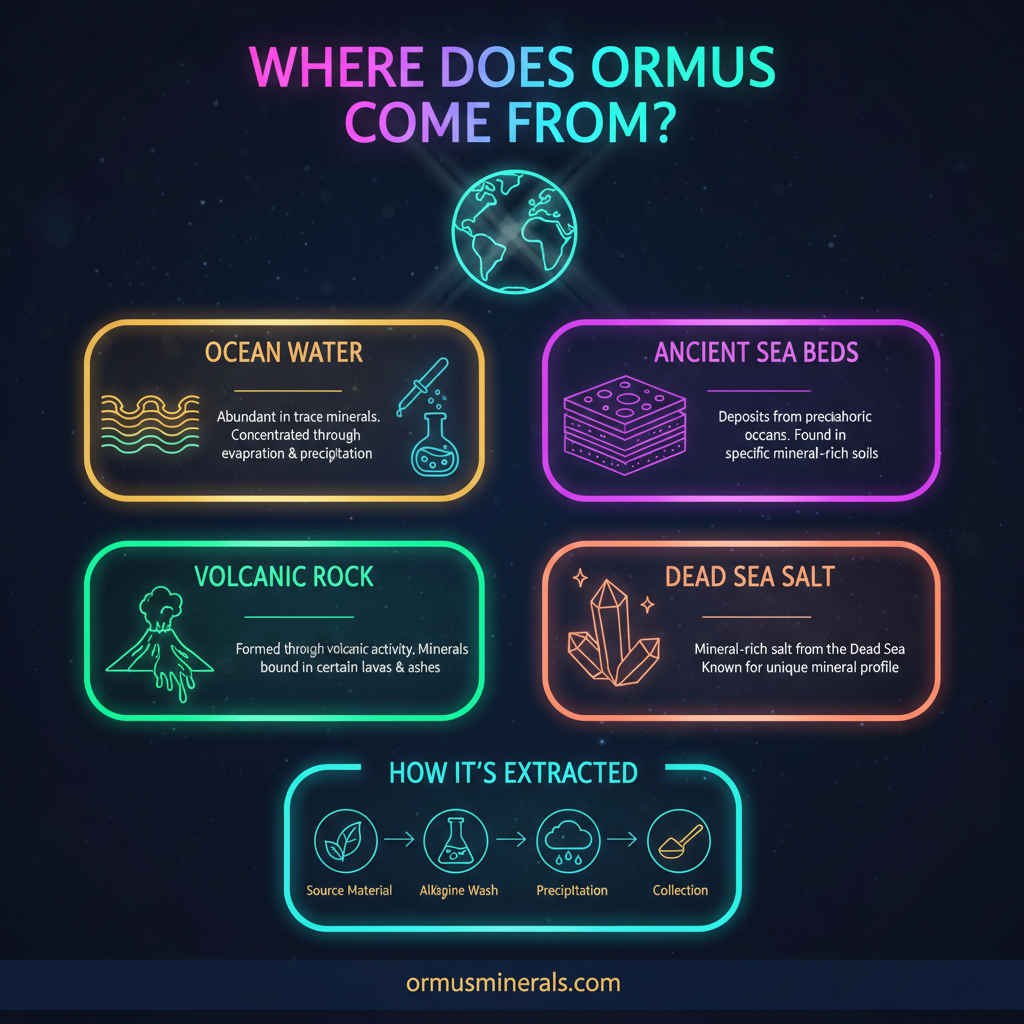

From Sacred Sea to You: Inside the Ormus Minerals Process Turning Invisible Elements into Tangible Results
How one small company built its reputation on meticulous sourcing, careful extraction, and uncompromising quality
By Staff Wellness Correspondent | March 23, 2026

Most people who hear about Ormus for the first time are intrigued by the effects.
Sharper focus. Calmer mood. Deeper sleep. Subtle but persistent shifts in energy, intuition, and resilience.
But very few ask the most important question:
Where does this come from, and how is it actually made?
In the Ormus world, that question matters more than almost anything else. Because unlike a simple vitamin tablet, Ormus is not just “what you take” — it’s how it’s prepared, where it’s sourced from, how it’s handled, and how much respect is built into every step.
That’s where Ormus Minerals stands out.
Ray Hamilton and his team have spent years refining their Ormus process — from the salts they select and the water they use, to the way they perform the “wet method” extraction and protect the final product. Their entire philosophy can be summed up in two words:
Source matters.
This is the story of what happens between “sacred sea” and the bottle in your hand — and why the invisible details make the visible difference.
Making the Invisible Visible: What Ormus Extraction Is Really About
At its core, Ormus work is about coaxing subtle, highly reactive forms of certain elements out of raw natural materials, then stabilizing them in a usable, bioavailable form.
In practice, that means:
- Starting with Ormus-rich natural sources — especially high-quality sea and mineral salts.
- Carefully separating dense, unwanted materials from the more delicate fraction believed to contain Ormus elements.
- Respecting the sensitivity of these elements to things like contamination, electromagnetic fields, and improper handling.
This is often done using a variation of the wet method — a step-by-step process that involves dissolving salts, adjusting pH, precipitating the desired fraction, washing it, and ultimately capturing the “white stone” or “milk” that many customers now know as Ormus.
On paper, the steps look almost simple. In real life, the difference between a clean, powerful Ormus and a harsh, contaminated product can come down to hundreds of tiny decisions in each batch.
The Wet Method: Why Technique Matters as Much as Ingredients
The wet method is at the heart of Ormus Minerals’ work.
At a high level, it involves:
- Dissolving carefully selected salts in high-quality water
- Raising the pH gradually to coax out a specific, subtle precipitate
- Allowing enough time for the Ormus-rich fraction to form and separate
- Washing away impurities while preserving the delicate structure of the Ormus
In theory, anyone can follow a basic recipe. In practice, Ray and his team treat the process more like a craft — paying attention to:
- Rate of pH adjustment. Go too fast and you shock the system, bringing down unwanted materials. Go too slow and the process stalls or shifts in the wrong direction.
- Temperature and timing. Subtle elements respond differently depending on how quickly each stage is carried out.
- Washing and decanting. Each wash removes contaminants and excess salts, but over-washing or rough handling can strip away what you actually want to keep.
That’s why Ormus Minerals has devoted entire internal chapters to advanced wet method tips — the fine-tuning that doesn’t show up in surface-level instructions but makes the difference between a batch that’s merely “okay” and one that customers feel almost immediately.
Sources of Ormus: Why Salt Is a Foundation, Not an Afterthought
Ormus can be prepared from many sources — including natural salts and, in some advanced work, from metallic gold itself. Ormus Minerals works with both salt-based and gold-related approaches, but for most people, the foundational Ormus comes from salts.
This is where choice of salt becomes critical:
- Dead Sea salt is famous for its dense mineral profile and has long been associated with both therapeutic and ceremonial uses.
- Himalayan salt and other high-mineral salts offer different balances of elements, each contributing its own “signature” to the final Ormus.
Ormus Minerals spends significant time on “Dead Sea vs. Himalayan” and other source comparisons, because:
- The ratio of magnesium, calcium, trace metals, and rare elements informs how the Ormus behaves.
- Impurities or industrial processing residues can undermine the entire effort.
- Each salt carries not only a chemical profile but a geological and energetic history — something long recognized in traditional mineral medicine.
When Ormus Minerals says “From Sacred Sea to You,” it reflects a real commitment: only working with salts that meet their standards for purity, mineral richness, and energetic quality.
Salt-Based vs. White Stone vs. Gold: Understanding the Types
Not all Ormus is the same.
Ormus Minerals works with several distinct families of preparations:
-
Salt-based Ormus (foundational Ormus)
Extracted from natural salts via the wet method, this is often the starting point for people new to Ormus. It tends to feel grounding, supportive, and broadly nourishing, with noticeable effects on mood, energy, and sleep. -
White stone / white gold-style Ormus
In some preparations, the process continues beyond the initial “milk” to drier, more concentrated forms. These may be experienced as more intense or “higher octave”, and are typically used by more experienced Ormus users. -
Gold-related Ormus (Ormus and Au)
In highly controlled processes, metallic gold can be brought through transformations that are believed to expose Ormus-like states. These are advanced, time-consuming, and extremely sensitive operations — not something done casually or at industrial scale.
Rather than chasing trends, Ormus Minerals focuses on:

- Getting salt-based Ormus right as a daily foundation.
- Offering white gold / Stardust-style preparations for those ready for refined work.
- Only engaging with gold-related Ormus under conditions that meet their standards for safety, purity, and integrity.
Quality and Purity: How Ormus Minerals Decides What Makes the Cut
Because Ormus is subtle, quality control has to go beyond basic lab numbers. Ormus Minerals approaches it on several levels:
- Ingredient screening. Salts and other inputs are chosen for mineral profile, provenance, and freedom from obvious contaminants.
- Process discipline. Batches are made in controlled environments, away from unnecessary electrical “noise” and interference, with careful attention to containers, tools, and water quality.
- Sensory and experiential checks. Over years of work, Ray and his close circle have developed a clear sense of how different batches “feel” — to the body, to mood, and in meditation. Batches that don’t meet that standard don’t go to customers.
0 comments