
🎧 Listen to this article (full narration)
Ormus vs Colloidal Gold: Understanding the Difference
Ormus and colloidal gold are two distinct products that are frequently confused — partly because both involve gold in their theoretical frameworks, and partly because both are marketed in wellness contexts. Understanding the real differences between them helps consumers make informed choices and set appropriate expectations for each.
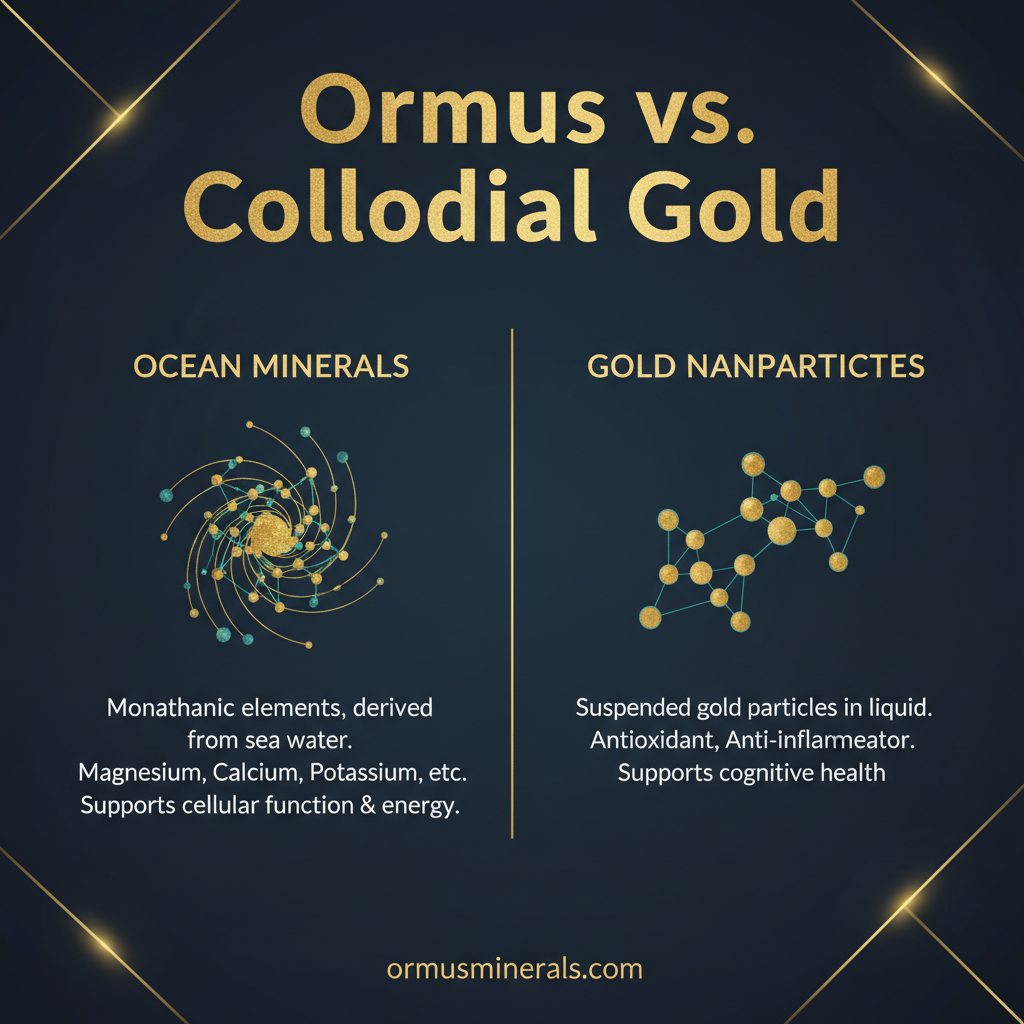
What Is Colloidal Gold?
Colloidal gold is a suspension of gold nanoparticles in liquid. These are actual metallic gold particles — typically 1–100 nanometers in size — suspended in deionized water. Colloidal gold is produced by reducing gold salts or by electrical processes that create gold particles small enough to remain suspended. The particles are metallic gold (Au0) in their elemental state, distributed through a liquid medium.
Colloidal gold has been studied for anti-inflammatory properties, and some research suggests potential benefits for joint health, cognitive function, and mood. It is distinct from ionic gold (dissolved gold ions) and from gold salt medications used in rheumatoid arthritis treatment.
What Is Ormus?
Ormus (ORME — Orbitally Rearranged Monoatomic Elements) is derived from ocean water through mineral concentration processes. The ocean mineral base provides the complete spectrum of ionic trace minerals — magnesium, zinc, selenium, potassium, and over 60 additional elements. The gold connection in Ormus comes from the theoretical framework proposed by David Hudson, who hypothesized that certain minerals (including gold and other precious metals) can exist in a high-spin monoatomic state with unique properties distinct from their normal metallic chemistry.
In practice, Ormus supplements contain ocean-derived trace minerals in ionic form — they are not concentrated colloidal or ionic gold supplements.
Key Differences
Composition: Colloidal gold contains metallic gold nanoparticles. Ormus contains the full ocean mineral spectrum — of which gold may be present in trace amounts in its theoretical monoatomic form.
Primary benefit focus: Colloidal gold research focuses mainly on anti-inflammatory and neuroprotective effects. Ormus provides comprehensive trace mineral nutrition across all mineral-dependent biological systems.
Mineral breadth: Colloidal gold is a single-element product. Ormus is a full-spectrum 70+ mineral product. For addressing mineral deficiency — the most common nutritional gap in modern populations — Ormus provides far broader coverage.
Cost: High-quality colloidal gold is significantly more expensive per serving than Ormus ocean mineral supplements due to the gold content.
Which Should You Choose?
For comprehensive trace mineral support — the most impactful nutritional foundation for energy, cognition, immunity, and overall health — Ormus ocean minerals offer broader benefit at more accessible cost. For targeted anti-inflammatory support or specific interest in gold nanoparticle research, colloidal gold has its own place. Many wellness practitioners use both for complementary reasons.
✦ Ready to experience it? ✦
Start with our most popular formula
Premium Dead Sea Ormus — crafted from Atlantic Ocean water, Dead Sea salt and Himalayan sole.
🚚 Free US shipping on orders over $50 · Use code ORMUS10 for 10% off your first order
Shop Gold Products
Each size is also available in strengths 1x–5x. Free US shipping on orders over $50.
0 comments