
🎧 Listen to this article (full narration)
Ormus vs Fulvic Acid: What's the Difference?
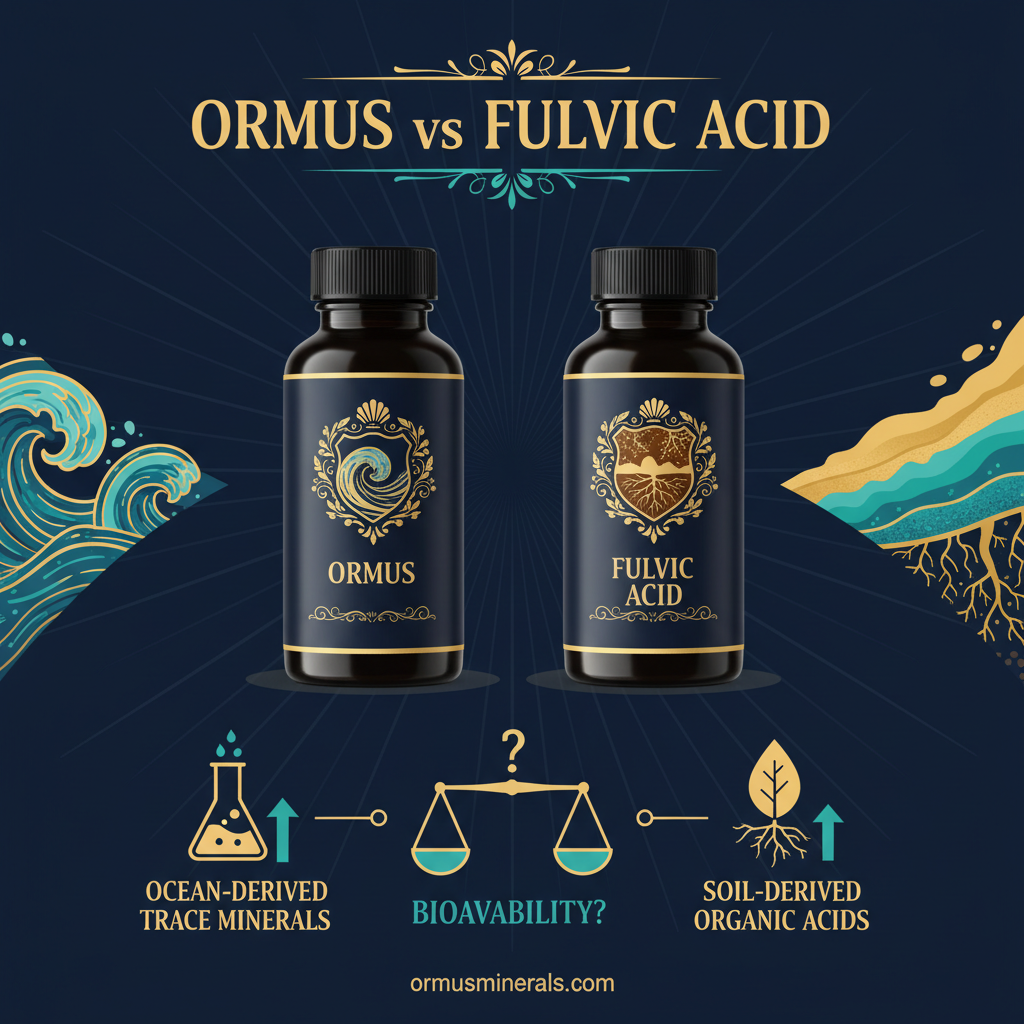
Ormus minerals and fulvic acid are two of the most talked-about natural mineral supplements — and they are often confused or compared directly. While both come from the natural world and both relate to mineral nutrition, they are fundamentally different substances that work through different mechanisms and offer complementary rather than competing benefits.
What Is Ormus?
Ormus (also called ORME — Orbitally Rearranged Monoatomic Elements) refers to ocean-derived ionic trace minerals, with the theoretical framework that certain transition and precious metal minerals can exist in a high-spin, single-atom state with unique properties. Practically, Ormus supplements are concentrated liquid mineral extracts from ocean water that provide the complete spectrum of ionic trace minerals — magnesium, zinc, selenium, potassium, boron, lithium, chromium, and over 60 additional trace elements — in a highly bioavailable liquid form.
What Is Fulvic Acid?
Fulvic acid is a naturally occurring organic acid produced by the microbial decomposition of organic matter in soil over geological timescales. It is a small-molecular-weight humic substance with a remarkable capacity to chelate (bind) mineral ions and transport them across biological membranes. Fulvic acid is not a mineral itself — it is a mineral delivery molecule. It binds to minerals present in soil or water and carries them into plant cells and animal cells with exceptional efficiency.
The Key Differences
Source: Ormus comes from ocean water. Fulvic acid comes from soil and decomposed organic matter.
What it is: Ormus is a mineral supplement — it provides minerals. Fulvic acid is a transport compound — it enhances mineral delivery but provides little mineral content itself.
Mechanism: Ormus delivers ionic minerals directly through the gut's mineral transport channels. Fulvic acid enhances absorption by chelating minerals and escorting them through cell membranes.
Benefits focus: Ormus provides broad-spectrum mineral nutrition. Fulvic acid primarily enhances the absorption and cellular delivery of whatever minerals it is taken alongside.
Which Is Better?
The better question is: which do you need? If your primary goal is ensuring comprehensive trace mineral sufficiency — getting all the minerals your body needs in bioavailable form — Ormus ocean minerals are the more complete solution. If you are specifically looking to enhance the absorption of minerals you are already getting from food or supplements, fulvic acid is a powerful tool.
The best approach for many people is both together. Several Ormus formulas — including Ormus Earth Milk — combine ocean minerals with fulvic acid precisely because the combination produces superior cellular mineral delivery compared to either alone. The ocean minerals provide the mineral content; the fulvic acid maximizes how efficiently those minerals reach your cells.
Bottom Line
Ormus and fulvic acid are not competing products — they are complementary. Ormus provides the minerals your body needs. Fulvic acid helps your cells absorb them more efficiently. Together they represent a comprehensive approach to trace mineral nutrition that neither provides as fully on its own.
✦ Ready to experience it? ✦
Start with our most popular formula
Premium Dead Sea Ormus — crafted from Atlantic Ocean water, Dead Sea salt and Himalayan sole.
🚚 Free US shipping on orders over $50 · Use code ORMUS10 for 10% off your first order
0 comments