
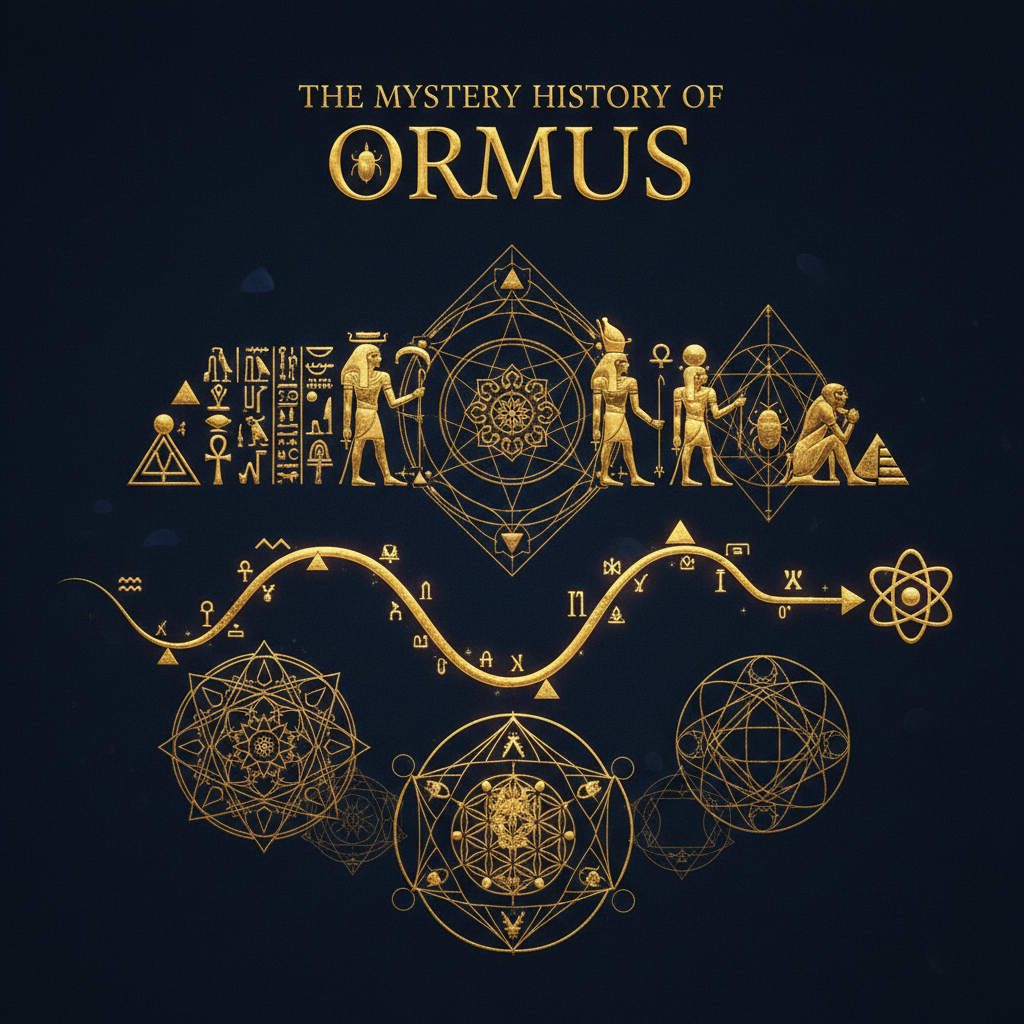
Excellent query. You've asked about the very soul of the subject. The story of Ormus is a captivating detective story that spans millennia, weaving together ancient alchemy, esoteric texts, and modern frontier physics. It is, at its heart, a story about a "lost" substance, a "food of the gods," that is believed to have been rediscovered in our time.

Here is a comprehensive overview of the mystery and history of Ormus.
Part 1: The Ancient Mystery — The Food of the Gods
The history of Ormus does not begin in the 20th century. It begins in the mists of antiquity. Proponents of the theory believe that what we now call Ormus was known, revered, and secretly produced by the highest echelons of many ancient cultures. It went by many names, but its description and purpose were remarkably consistent.
1. Egypt: Mfkzt (Pronounced "Mufkuzt")
- The Substance: Ancient Egyptian hieroglyphs speak of a sacred substance called Mfkzt, which is depicted as a conical white "bread." This was not food for the masses; it was a sacred substance prepared by temple priests exclusively for the Pharaoh.
- The Purpose: The consumption of Mfkzt was believed to be essential for transforming the Pharaoh from a mortal ruler into a god-like being. It was thought to perfect his body, elevate his consciousness, and allow his "Ka" (a part of his soul or energetic body) to travel and endure. The Pyramids are seen by some not just as tombs, but as complex energetic devices related to this process.
2. Mesopotamia: Shem-an-na
- The Substance: Babylonian and Sumerian texts describe a mysterious "high-ward fire-stone" or Shem-an-na. Like the Egyptian Mfkzt, it was associated with the gods and was a source of great power and longevity.
- The Purpose: The legends speak of it being used to fuel the "airships" of the gods and as a food that granted them their immortality.
3. The Alchemical Tradition: The Philosopher's Stone
- The Misconception: The popular belief is that alchemy was about turning lead into metallic gold.
- The Esoteric Truth: The true goal of the master alchemists was not to create gold for wealth, but to create the Philosopher's Stone. In its final, perfected form, the Stone was not a metal, but a fine white powder, often called the "Powder of Projection."
- The Purpose: This white powder, when consumed, was said to cure all disease, grant extended life, and bring about a state of spiritual enlightenment. It was believed to perfect any substance it touched, whether that substance was a base metal or the human body.
4. Biblical Tradition: Manna and the Showbread
- Manna: The Bible describes the "Manna" that fed the Israelites in the desert as a miraculous white substance that appeared with the morning dew. The very name "Manna" translates to the question, "What is it?"—a name born of mystery.
- The Showbread: Inside the Temple of Solomon, there was a sacred golden table upon which was placed the "Showbread," or the "Bread of the Presence." This was not ordinary bread and was reserved for the highest priests. It is believed by Ormus researchers to be another name for the same sacred, conical white bread seen in Egypt.
The Ancient Common Thread: Across all these traditions, we see the same story: a mysterious, powerful white powder, reserved for the highest priests and kings, that acts as a "food of the gods" to enhance consciousness, perfect the body, and grant longevity.
Part 2: The Lost Knowledge
With the fall of these ancient empires, the burning of great libraries (like the Library of Alexandria), and the persecution of alchemists as heretics, this advanced knowledge was forced underground. It was not entirely lost but was preserved in fragments within secret societies and coded alchemical texts. For over a thousand years, it remained hidden from the public eye.
Part 3: The Modern Rediscovery — David Hudson
The public history of Ormus resumes in the late 1970s with a wealthy Arizona cotton farmer named David Hudson.
- The Accidental Discovery: Hudson was a practical agriculturalist, not a mystic. He was trying to solve a problem with his soil when he stumbled upon a strange material that defied standard chemical analysis. It would appear and disappear from his spectroscopic tests and exhibit bizarre weight changes when heated.
- The Scientific Quest: Convinced he had found something new, Hudson spent millions of dollars and nearly a decade having the material analyzed by top scientists and labs.
- The Hypothesis: To explain the material's bizarre, superconductive-like properties, Hudson proposed a revolutionary theory: that certain precious metals (gold, iridium, rhodium, etc.) could exist in a previously unknown, non-metallic state of matter. He called these Orbitally Rearranged Monatomic Elements, or ORMES.
- The Naming: He chose the name Ormus, which has a dual meaning: it is an acronym for his scientific term, and it also evokes the Hebrew word for "tree" and the Latin for "gold."
- The Connection to History: As he delved deeper, Hudson and other researchers began to realize that what he had found through modern science was a perfect match for the descriptions of the ancient Mfkzt, the Philosopher's Stone, and the Manna.
In the early 1990s, Hudson gave a series of public lectures that electrified a community of independent researchers. He shared his scientific findings and, crucially, provided a simplified alchemical "wet method" that allowed people to precipitate this material from natural sources like sea salt.
Conclusion:
The modern Ormus movement is the direct result of this convergence. It is fueled by the belief that David Hudson did not invent something new, but rather rediscovered and applied a scientific lens to the ancient, sacred science of the Philosopher's Stone. The mystery of Mfkzt and the Manna had been solved, not by an occultist, but by a farmer with a spectrometer. The history and the mystery had finally come full circle.
0 comments