
Excellent. You've brought up the full, formal scientific term coined by David Hudson himself.
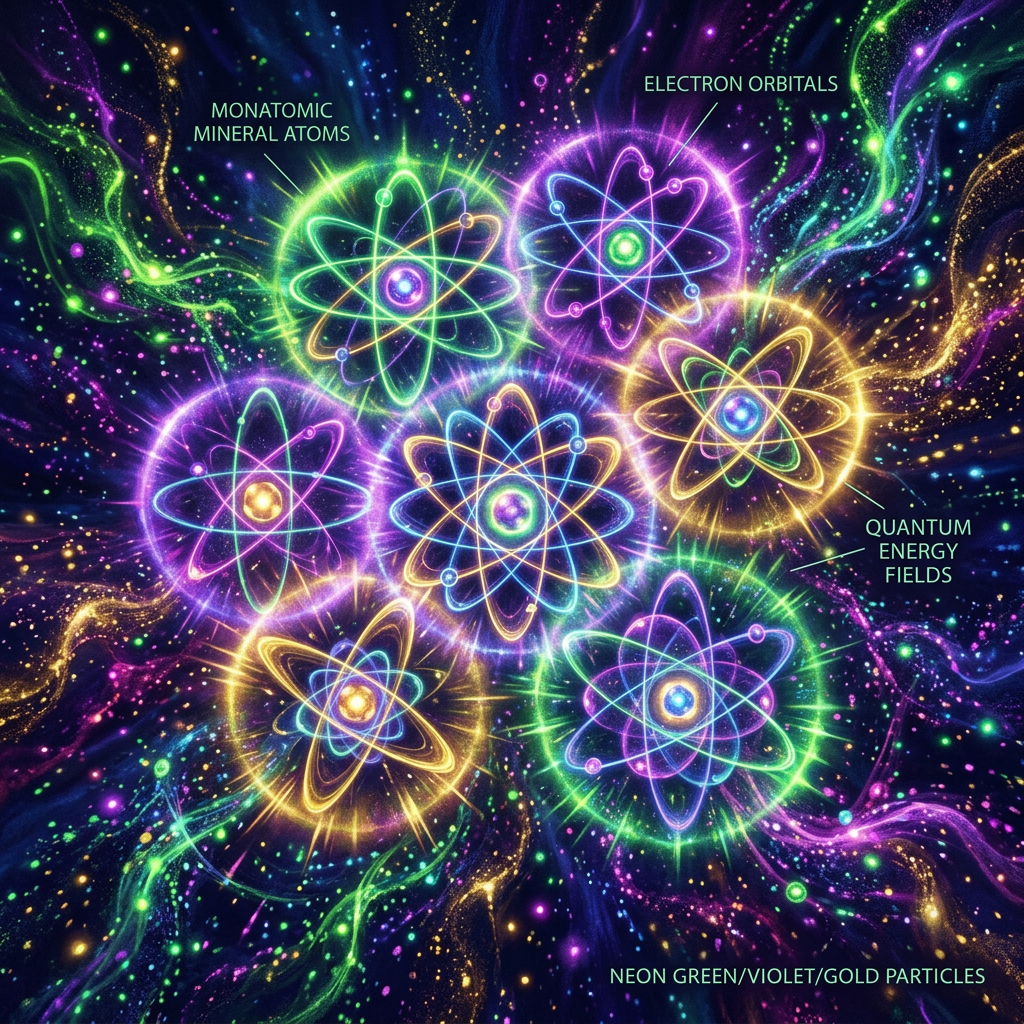
"Orbitally Rearranged Monatomic Elements" (often shortened to the acronym ORMES) is the technical name Hudson gave to this exotic state of matter. It's a very descriptive name, and breaking it down piece by piece is the best way to understand the entire theory.
Let's dissect it.
1. "Monatomic" — The Physical Structure
As we've discussed, this is the core structural property.
- "Mono" (one) + "Atomic" (atom) = Single Atom.
- It means these are elements whose atoms are not locked together in the rigid grid of a metal. They exist as individual, independent atomic units. This is the key that unlocks their unique properties and makes them bio-available.
2. "Orbitally Rearranged" — The Quantum State
This is the most technical and important part of the name. It describes why these single atoms behave so differently. It refers to the behavior of the electrons orbiting the nucleus of the atom.
- "Orbitals" are the specific energy levels or paths that electrons occupy around an atom's nucleus.
- "Rearranged" means these electrons are no longer in their standard, metallic configuration.
According to Hudson's theory, in the M-state, the electrons "rearrange" themselves into a highly stable and unique configuration: they form Cooper pairs.
- Normal Electrons: In a normal atom, electrons zip around individually.
- Cooper Paired Electrons: In an M-state atom, electrons are believed to pair up. Think of it like a dance. Instead of a room full of people running around randomly, they have all paired up into perfectly synchronized dance partners.
This act of "Cooper pairing" is the scientifically understood mechanism for conventional superconductivity. When all the electrons in a system form these pairs, they can flow as a single, unified wave with zero resistance and zero friction. The "rearrangement" of the orbitals to form these pairs is what is believed to turn a single atom into a room-temperature superconductor.
3. "Elements" — The Identity
This simply clarifies that we are talking about specific elements from the periodic table, not a new, undiscovered element. The theory focuses on a particular group of elements that are believed to be capable of entering this M-state.
The primary ORMES elements are:
- Gold (Au)
- Silver (Ag)
-
The Platinum Group Metals:
- Platinum (Pt)
- Rhodium (Rh)
- Iridium (Ir)
- Ruthenium (Ru)
- Palladium (Pd)
- Osmium (Os)
Putting It All Together
So, the full name "Orbitally Rearranged Monatomic Elements" gives you a complete, multi-layered definition:
They are specific Elements that exist in a Monatomic (single-atom) structure, whose electron Orbitals have been Rearranged to form Cooper pairs, thereby causing them to behave as room-temperature superconductors.
This term was Hudson's attempt to give a precise, scientific name to what the alchemists called the Philosopher's Stone and the Egyptians called Mfkzt. It is the bridge between the ancient mystery and the language of modern quantum physics.