
🎧 Listen to this article (full narration)
Last Updated: November 2, 2026
Quick Summary
For most people, M-state mineral supplementation is not clearly worth it, because the strongest claims lack controlled human trials. Products may suit someone who accepts that uncertainty and compares cost per serving against conventional minerals. Anyone with a diagnosed deficiency or medication concerns should consult a clinician first.
- Controlled human trials of M-state products were not verified for mental clarity or energy claims.
- Calculate cost per serving by dividing bottle price by number of servings per bottle.
- Check whether the label states elemental mineral content per serving before buying.
- Iron, calcium, and zinc can interact with antibiotics and thyroid medication.
- Start with one product for a defined trial period at the labeled dose.
Table of Contents
- What M-State Minerals Are and What Brands Claim
- What the Evidence Actually Shows for Mental Clarity and Energy
- M-State Mineral Supplement Reviews: What Customers Report
- Cost Per Serving: M-State Products Compared With Conventional Minerals
- Mineral Supplement Safety, Interactions and Who Should Avoid Them
- How to Choose a Mineral Supplement and Decide If It Is Right for You
- Frequently Asked Questions
Is M-state mineral supplementation worth it? For most people the honest answer is: it depends on what you expect it to do, and the evidence for the strongest claims is thin. At Ormusminerals, we make M-state products, so we have a stake in this question. This guide sets out what M-state minerals are, what the evidence supports, what customers report, how cost compares, and how to decide whether a product fits your situation.
What M-State Minerals Are and What Brands Claim
Products in this category are often described as coming from Dead Sea salt and Atlantic Ocean water. For a fuller background, read our M-State Elements: Uses, Claims, and Scientific Reality page.
Some of those claims rest on customer testimony. Others rest on mechanisms that have not been tested in published human trials specific to these products. Keep the two apart as you read.
What the Evidence Actually Shows for Mental Clarity and Energy
Some people report better focus, steadier energy, or deeper sleep after starting M-state products. Those reports are real experiences, but they do not establish that the product caused the change.
For mental clarity and energy specifically, the research we could verify does not include controlled human trials of M-state products. Read the full evidence review for mental clarity and energy claims. Brain fog and fatigue have many causes, including sleep problems, thyroid conditions, anemia, medication effects, and stress.
Anecdotal reports versus clinical evidence
There is a real difference between what people experience and what has been measured. Testimonials can be sincere and still be unreliable as evidence, because there is no comparison group, no blinding, and no control for expectation.
Clinical evidence, by contrast, compares a product against placebo or a control over a defined period and measures outcomes in a consistent way. For the claims made about M-state products, that kind of evidence is not something we could confirm from the research available for this article.
Proposed mechanisms: cellular communication and DNA claims
Some brands describe M-state minerals as improving "cellular communication" or affecting DNA. These are mechanism claims: explanations of how a product might work. A mechanism claim is only meaningful if it has been demonstrated in a relevant study. We were unable to verify such studies for M-state products, so these explanations should be read as hypotheses rather than established science.
M-State Mineral Supplement Reviews: What Customers Report
Some customers describe changes in how they feel after using our products. Feedback like this is useful for understanding the customer experience, but it is self-selected and unverified.
Before buying, read reviews across several sources, look for specific detail rather than generic praise, and pay attention to whether complaints concern taste, texture, dosing, or results.
Cost Per Serving: M-State Products Compared With Conventional Minerals
The keyword asks whether M-state supplementation is worth it, and worth is a value question, not just a benefit question. Most articles on this topic skip cost entirely.
Our current prices
- Ormus C11 Manna: $20.00
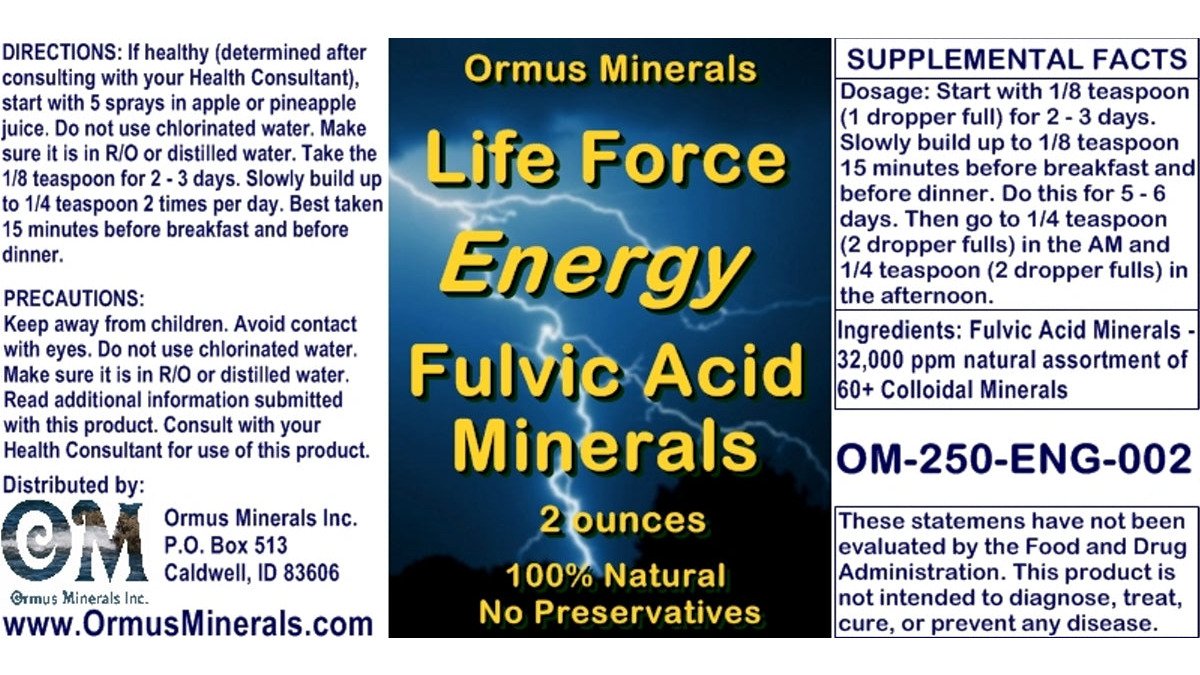
- Life Force Energy Fulvic Acid Minerals: $15.00
- Ormus Earth Milk Fulvic Acid: $40.00 (designed for plants and gardens, not for personal supplementation)
- Ormus C11 Gold, Colloidal Copper Imprinted: $20.00
How to calculate cost per serving
Cost per serving = bottle price ÷ number of servings per bottle. Servings per bottle = bottle volume ÷ labeled dose per serving. Do this for every product you compare, including ours. A $15.00 bottle with 30 servings is $0.50 per serving; a $20.00 bottle with 60 servings is $0.33 per serving.
How conventional mineral supplements compare
Conventional single-mineral products, magnesium glycinate or citrate capsules, zinc picolinate, iron bisglycinate, are typically sold in bottles of 60 to 120 capsules, with one or two capsules per serving. At common retail prices, cost per serving for these products usually lands in the range of a few cents to roughly a quarter per serving, depending on the mineral, the form, and the dose. That is generally lower per serving than a specialty M-state product, but the comparison is only fair if you match three things:

- The mineral. Magnesium and zinc are not interchangeable with a broad-spectrum M-state concentrate.
- The dose. Compare milligrams of elemental mineral per serving, not milliliters of liquid.
- The form. Oxide, citrate, glycinate, and picolinate have different absorption profiles and different prices.
We have not independently verified current market pricing across every conventional brand for this article, so treat the ranges above as a framework for your own comparison rather than a fixed benchmark. Check the label, do the division, and compare like with like.
What you are actually paying for
With a conventional mineral supplement, most of the price reflects the cost of a defined, assayed amount of a specific mineral compound. With an M-state product, part of the price reflects the mineral content and part reflects the processing, the brand, and the positioning. That is not automatically a bad deal, specialty products often cost more, but it does mean you should ask what the label verifies.
The article lays out our current prices, so readers can compare them directly.
| Product | Price | Note |
|---|---|---|
| Ormus C11 Manna | $20.00 | Compare cost per serving |
| Life Force Energy Fulvic Acid Minerals | $15.00 | Compare cost per serving |
| Ormus Earth Milk Fulvic Acid | $40.00 | For plants and gardens, not personal use |
| Ormus C11 Gold, Colloidal Copper Imprinted | $20.00 | Compare cost per serving |
Mineral Supplement Safety, Interactions and Who Should Avoid Them
Safety is where the 'worth it' question gets practical. A product with modest benefits and low risk may still be worth trying; a product with modest benefits and real interaction risk usually is not. This section gives concrete guidance rather than a generic disclaimer.
Known mineral interactions
Mineral supplements can interact with medications and with each other. Well-documented examples include:
- Iron competes with calcium and can reduce absorption of some antibiotics (tetracyclines and fluoroquinolones) and thyroid medication. Iron should not be taken without a documented reason, because excess iron can be harmful.
- Calcium reduces absorption of iron, zinc, and some antibiotics; separate doses by a few hours.
- Zinc at high doses can interfere with copper absorption over time and can reduce absorption of certain antibiotics.
- Magnesium can reduce absorption of some antibiotics and bisphosphonates, and high doses can cause loose stools.
- Potassium supplements can interact with ACE inhibitors, ARBs, and potassium-sparing diuretics.
Because M-state products are typically marketed as broad mineral concentrates, the safest assumption is that any interaction that applies to the constituent minerals may apply to the product. If you take prescription medication, ask a pharmacist to review the product label against your medication list before you start.
Who should avoid mineral supplementation without clinician guidance
Consult a doctor or pharmacist before starting any mineral supplement if you:
- Are pregnant or nursing
- Have kidney disease or impaired kidney function
- Take prescription medication, especially antibiotics, thyroid medication, blood thinners, or blood pressure medication
- Have a condition that affects mineral levels, such as hemochromatosis, Wilson's disease, or a diagnosed deficiency
- Are scheduled for surgery
Parents should keep all supplements, including liquid dropper products, out of reach of children. Liquid products in particular can be mistaken for beverages.
What to do if you notice an adverse effect
Stop use and contact a clinician if you experience gastrointestinal upset, rash, headache, or any symptom that concerns you. Keep the bottle and label so a clinician or pharmacist can see exactly what you took and at what dose. Report serious adverse events to the FDA's MedWatch program (the FDA).
The risk-benefit calculation
For a reader with a diagnosed deficiency, the risk-benefit math is usually favorable: a clinician has identified a gap, and a defined mineral supplement addresses it. For a reader with normal lab results considering an M-state product for subjective effects such as focus or energy, the math is different, the benefits are unverified in controlled trials, so the acceptable risk threshold should be lower.
How to Choose a Mineral Supplement and Decide If It Is Right for You
Use a simple process rather than relying on marketing. Compare other well-regarded supplements for cellular health.
- Define the goal. Be specific. "Better focus" is harder to judge than "confirm whether I am low in magnesium." See a step-by-step guide to judging supplement quality before you buy.
- Check whether a deficiency is likely. A basic blood test or conversation with a clinician can help identify a true gap.
- Read the label. Look for the exact mineral, the amount per serving, and the ingredient list. Be cautious of vague wording.
- Compare cost per effective dose, not bottle price.
- Start with one product for a defined trial period, and note changes in how you feel.
- Keep expectations realistic. A supplement is a support, not a cure for fatigue or cognitive symptoms.
Bottom line: M-State supplementation may suit someone who wants a mineral product and accepts that the strongest claims are not yet backed by controlled human evidence. It is a poor fit for anyone expecting it to replace medical care, or for anyone who cannot afford to test whether it helps.
Frequently Asked Questions
What are M-state minerals, and how are they different from regular minerals?
M-state, or monatomic, minerals is a term used by brands such as Ormusminerals for mineral preparations made from Dead Sea salt and Atlantic Ocean water. The brand describes them as existing in a single-atom state. This claim is not supported by independent peer-reviewed research, and the concentrations of minerals in these products are rarely disclosed. Before buying, check the supplement facts panel for the actual mineral content and serving size. Ask whether the product has third-party testing for heavy metals and purity.
Is there scientific evidence that M-state supplements provide health benefits?
No large, independent clinical trials have tested M-state mineral products for mental clarity, energy, sleep or cellular regeneration. The claims rest mostly on brand materials and customer testimonials, which cannot show cause and effect. Established minerals such as magnesium, iron and zinc do have documented roles, and deficiency is treated with them under medical supervision. A blood test can show whether you are low in a specific mineral before you spend money on any supplement.
Are M-state mineral supplements safe to take?
Mineral supplements can cause problems when taken in excess or alongside medications. Too much iron can cause stomach upset and, in people who do not need it, harm to organs. Magnesium can cause diarrhea, and some minerals interfere with thyroid medication or antibiotics. Because M-state products often list no clear dose of individual minerals, it is hard to judge intake. Check with a pharmacist or doctor before starting, especially if you take prescription drugs, are pregnant or have kidney disease.
How can you tell whether a mineral supplement is worth the cost?
Divide the price by the number of servings to find the cost per serving, then compare it with a standard mineral supplement that lists the exact milligrams of each mineral. Ormusminerals sells Ormus C11 Manna for $20.00, Life Force Energy Fulvic Acid Minerals for $15.00, Ormus Earth Milk Fulvic Acid for $40.00 and Ormus C11 Gold Colloidal Copper Imprinted Ormus for $20.00. Only pay the premium if the label, testing and your own deficiency status justify it.

0 comments